Showing posts with label Historical Fiction. Show all posts

Monday, 4 April 2022

Book Review: THE PILOT'S WIFE by Catherine Hokin


THE PILOT'S WIFE

by
Catherine Hokin


Publication Date: 04 April, 2022

Publisher: Bookouture


About the Book

‘Smile, nod, and don’t breathe a word of what happens here. Or I’ll put you on the next train to Auschwitz myself.’

Four years later. Hanni Winter shivers in her thin coat as she hurries through the empty Berlin streets to her job. Despite the freezing winter and poverty all around, her cheeks flush when she meets the man she is photographing today, charismatic Tony Miller, the American pilot risking his life to bring food and provisions to the starving people of the city. But her rush of joy turns to ash as she sees the man behind him…

It’s been years since Hanni fled her terrible past, but seeing Reiner Foss now brings back harrowing memories of the man they called The Showman, and of the concentration camp he commanded. The last time she tried to expose him, Hanni almost died, can she dare to try again? Or should she seize the chance she sees in Tony’s sparkling eyes to leave the horrors of the war behind?

Hanni is no longer the frightened child she was when the Nazis devastated her life beyond repair. She vows to avenge every person who suffered at Reiner’s hands. But does her attraction to Tony leave her vulnerable? Can Hanni protect her loved ones from her past, or will the cost of fighting her demons ultimately prove more than she can pay?

My Thoughts

THE PILOT’S WIFE by Catherine Hokin is the second book in the Hanni Winter series. It can be read as a stand-alone, but if you can fit it into your reading time, I recommend the full experience of starting with book one.

It’s 1948 in a divided Berlin. We are introduced to the alluring (and fictitious) American pilot, Tony Miller. He is one of the many helping Berlin residents by flying in to the Western zones the much needed food and supplies that the city residents have been cut off from. Miller is definitely there to help but he also has his own personal reasons for wanting to be in Berlin.

Hanni Winter is a photographer with the police department. She also freelances, and it’s at a public relations event that she meets the charismatic Miller, and like many others is drawn into his captivating sphere. But a spate of seemingly unrelated murders finds Hanni again working closely with Detective Inspector Freddy Schlüssel. The same Freddy that Hanni has feelings for but knows she cannot be with because of past secrets.

Hokin deftly weaves into her story real historical events (the Berlin Blockade and the Berlin Airlift), a compelling mystery and an, albeit, unrequited (for now) romance. This is a book filled with secrets and a story about the lengths people will make to keep those secrets hidden. I enjoy these looks into post-WWII life in Germany that Hokin is giving us. I especially like that while every character is a singular being, their souls are not; they carry the weight of their family and ancestors, be they perpetrators or victims.  Such burdens can inspire great things in people, but they can also bring out the opposite. There is definitely no shortage of people willing to take advantage, especially when even the ‘good guys’ make choices in their own interests and not in the interest of victims.

The story is well paced and kept my interest from start to finish. Many loose ends are tied up but there are a few major ones that clearly form a larger story arc for the series. I am unsure how many books the author plans for this series, but there has got to be at least one more. Please tell me there’s at least one more!  And make sure to read the Acknowledgements. Hokin has listed several of the sources used in this book if you would like to read further about the historical events mentioned in The Pilot’s Wife.      


Review copy courtesy of Netgalley and Bookouture. 


***
About the Author
Catherine Hokin is the author of several World War Two inspired novels set in Berlin, her favourite city. Following a History degree at Manchester University she worked in teaching, marketing and politics, while waiting for a chance to do what she really wanted, which was to write full time. Her short stories have been published by iScot, Writers Forum and Myslexia magazines and she was the winner of the 2019 Fiction 500 Short Story Competition. She is a lover of strong female leads and a quest.

Catherine now lives in Glasgow with her American husband. She has two grown-up children – one of whom lives, very conveniently, in Berlin – and a lifelong addiction to very loud music.


https://www.catherinehokin.com/


***
Blog Tour


Wednesday, 16 March 2022

Book Review: LESSONS IN CHEMISTRY by Bonnie Garmus


LESSONS IN CHEMSTRY

by
Bonnie Garmus


Publication Date: 29 March 2022
Publisher: Penguin


About the Book

Chemist Elizabeth Zott is not your average woman. In fact, Elizabeth Zott would be the first to point out that there is no such thing as an average woman. But it's the early 1960s and her all-male team at Hastings Research Institute takes a very unscientific view of equality. Except for one: Calvin Evans; the lonely, brilliant, Nobel-prize nominated grudge-holder who falls in love with--of all things--her mind. True chemistry results.

But like science, life is unpredictable. Which is why a few years later Elizabeth Zott finds herself not only a single mother, but the reluctant star of America's most beloved cooking show Supper at Six. Elizabeth's unusual approach to cooking ("combine one tablespoon acetic acid with a pinch of sodium chloride") proves revolutionary. But as her following grows, not everyone is happy. Because as it turns out, Elizabeth Zott isn't just teaching women to cook. She's daring them to change the status quo.

Laugh-out-loud funny, shrewdly observant, and studded with a dazzling cast of supporting characters, Lessons in Chemistry is as original and vibrant as its protagonist.


***
My Thoughts

Without doubt LESSONS IN CHEMISTRY by Bonnie Garmus will be one of my 2022 top reads. It’s original and creative; a refreshing and delightful mix of quirky, humorous, and sincere.

It’s the early 1960s and having been effectively barred from a career in science, Elizabeth Zott (a woman and a single mother – gasp!) finds herself the reluctant host of a live TV cooking show. Elizabeth soon becomes the housewife’s superhero with not only her pragmatic and scientific approach to cooking, but her respect for them as intelligent women performing an unappreciated role.  

Things are a little more chaotic in her personal life. She is struggling with episodes of depression, her daughter is insatiably curious about the concept of family, her boss is forever pleading with her to be ‘normal’, and her neighbour is (at first) equal parts judgmental and jealous of Elizabeth.    

As the story progresses, Elizabeth and her motley crew - including a dog named six-thirty - become a family of sorts. They learn from each other, they lean on each other, and they help each other.

A captivating story from debut author Bonnie Garmus. I am eagerly waiting to see what she brings us next. 


Review copy courtesy of Better Reading (Australia) and the publisher.


***
About the Author

Bonnie Garmus is a copywriter and creative director who has worked widely in the fields of technology, medicine, and education. She’s an open-water swimmer, a rower, and mother to two pretty amazing daughters. Born in California and most recently from Seattle, she currently lives in London with her husband and her dog, 99.

https://www.bonniegarmus.com/

Saturday, 29 January 2022

Book & Audio Review: CALL ME ATHENA: Girl From Detroit by Colby Cedar Smith


CALL ME ATHENA: Girl from Detroit

by
Colby Cedar Smith


Publication Date: 17 August, 2021

Publisher: Andrews McMeel Publishing


About the Book

This enchanting novel in verse captures one young woman’s struggle for independence, equality, and identity as the daughter of Greek and French immigrants in tumultuous 1930s Detroit.

Call Me Athena: Girl from Detroit is a beautifully written novel in verse loosely based on author Colby Cedar Smith’s paternal grandmother. The story follows Mary as the American-born daughter of Greek and French immigrants living in Detroit in the 1930s, creating a historically accurate portrayal of life as an immigrant during the Great Depression, hunger strikes, and violent riots.

Mary lives in a tiny apartment with her immigrant parents, her brothers, and her twin sister, and she questions why her parents ever came to America. She yearns for true love, to own her own business, and to be an independent, modern American woman—much to the chagrin of her parents, who want her to be a “good Greek girl.”

Mary’s story is peppered with flashbacks to her parents’ childhoods in Greece and northern France; their stories connect with Mary as they address issues of arranged marriage, learning about independence, and yearning to grow beyond one’s own culture. Though Call Me Athena is written from the perspective of three profoundly different narrators, it has a wide-reaching message: It takes courage to fight for tradition and heritage, as well as freedom, love, and equality.


***
My Thoughts

CALL ME ATHENA is my first experience of a novel in verse. I partially read, but mostly listened to the book, and I was pleasantly surprised at how much I enjoyed the experience. With a brevity of words, it takes skill to bring to life such a multi-layered story as this one, and for me, Colby Cedar Smith has succeeded.

The chosen narrators all did a great job, and Gail Shalan was outstanding. Her portrayal of Mary was perfect, showing us a young child teetering – or rather, being pushed – into the world of adulthood.  I understood the young girl, still taking pleasure from simple things like riding a bike and a rare sweet treat. I felt her wonder and enjoyment as she experienced things for the first time.  I felt her fear at a life she was facing due to her economic circumstances. I feel her hope in wanting a different life – one she has a say in.

This story mainly takes place in the 1930s in Detroit, a major industrial city in the USA, feeling the effects of the Great Depression. Jobs are disappearing, money is scarce, and there are no social safety nets. Not only is Mary’s family impoverished, she and her siblings have to cope with the pressure of cultural expectations, especially Mary and her sister, being the only two girls.

The story also flashes back to WWI, and in a mostly epistolary format, we learn about Mary’s parents, Gio and Jeanne. These letters seem like fantasy; they are far removed from the Gio and Jeanne that Mary lives with daily. The grind of everyday life, and never-ending hardship has shaped them into something unrecognisable from the people in those letters.

I was invested in Mary as a character, and there’s a part of me that hopes we get a continuation of her story. 

And while I try not to judge a book by its cover, check out what a beauty this one is. Gorgeous!

Review copy courtesy of Netgalley, Andrews McMeel Publishing and Andrews McMeel Audio. 


***
About the Author


Colby Cedar Smith’s award-winning poetry has been published in numerous magazines including Mid-American Review, Pleiades, and The Iowa Review. She has been a finalist for over twenty poetry prizes including including The Iowa Review Poetry Award, the New Letters Poetry Prize, the Colorado Prize for Poetry; and a semi-finalist for the 92Y “Discovery”/Boston Review Poetry Prize. In 2020, Colby received a New Jersey Council on the Arts Fellowship in Poetry. 

Her debut novel in verse, Call Me Athena: Girl from Detroit (Andrews McMeel, 2021) is a Junior Library Guild Gold Selection Standard Selection; an American Booksellers Association Kids’ Indie Next Pick; a #1 Amazon August New Release in 20th Century Historical Fiction, and Teen Poetry; a Cybils Award Poetry Finalist; a 2021 Goodreads Choice Best Poetry Nominee, and a 2022 Michigan Notable Book. 

Her work has been featured in Forbes, YALSA’s the Hub, New Jersey Stage, SCBWI Insight, and Detroit's NPR station WDET. You can connect with her on Twitter @ColbyCedar, or Instagram @Colby_Cedar_Smith

Wednesday, 26 January 2022

Book Review: THE COMMANDANT'S DAUGHTER by Catherine Hokin


THE COMMANDANT'S DAUGHTER

by
Catherine Hokin


Publication Date: 26 January, 2022

Publisher: Bookouture


About the Book

A heartbreaking novel about the incredible courage of ordinary people during the Second World War. Fans of The Alice Network, The Nightingale and The Tattooist of Auschwitz will never forget this powerful story of hope found in the darkest days.

1933, Berlin. Ten-year-old Hanni Foss stands by her father watching the celebrations marking Adolf Hitler as Germany’s new leader. As the torchlights fade, her safe and happy childhood changes forever as Reiner, the father she adores, is corrupted by his new position as commandant of an infamous concentration camp…

Twelve years later. As the Nazi regime crumbles, Hanni hides from her father on the outskirts of Berlin. In stolen moments, she develops the photographs she took to record the horrors of the camp – the empty food bowls and desperate faces – and vows to get justice for the innocent people she couldn’t help as a child.

But her carefully constructed new life is threatened when Hanni discovers a body hidden in a bombed-out building, and meets Freddy, the tortured young detective in charge of the case. Could the fierce emotion in his brown eyes distract Hanni from her quest for atonement?

Or will Reiner stop her himself? Because on the day she plans to deliver her damning photographs to the Allies, Hanni comes face to face with her father again. Reiner Foss has a powerful new identity and he makes it clear just how dangerous it will be to expose him. Now she faces a devastating choice, between the past which haunts her, and the chance of a future with Freddy…


*

Buy Link

Amazon: https://bit.ly/3mcGSz8


***

My Thoughts

THE COMMANDANT’S DAUGHTER by Catherine Hokin is the first book in the Hanni Winter series.

Recently, I’ve been drawn to WWII historical fiction books where the perspective is that of German people living in Germany during WWII. Having to live through the war, deal with their individual and collective losses, as well as rebuild and reinvent themselves is a field ripe for the picking for authors . This book certainly ticks those boxes.

Making Hanni Winter a photographer is a clever way of giving her entry into places and circumstances she would not typically be able to access. It’s through her photography that she meets Inspector Freddy Schlüssel from the German police force; a unit that is hampered by corruption in bringing law and order. They bond over their mutual attraction as well as their desire to solve a series of recent murders.

For me, this is a story about survival. How do the guilty reinvent themselves? How do victims rise above the horrors they have experienced? Hokin gives us an interesting mix of characters along a spectrum from the truly abhorrent characters through to innocent, blameless victims.   

Hokin has done an admirable job in blending fact and fiction to both educate and entertain readers, as well as giving us plenty of material to think about once the last page has been turned. 


Review copy courtesy of Netgalley and Bookouture. 


***
About the Author


I seem to have followed a rather meandering career, including marketing and teaching and politics (don't try and join the dots), to get where I have always wanted to be, which is writing historical fiction. I am a story lover as well as a story writer and nothing fascinates me more than a strong female protagonist and a quest. Hopefully those are what you will encounter when you pick up my books.

I am from the North of England but now live very happily in Glasgow with my American husband. Both my children have left home (one to London and one to Berlin) which may explain why I am finally writing. If I'm not at my desk you'll most probably find me in the cinema, or just follow the sound of very loud music.

I'd love to hear from you and there are lots of ways you can find me, so jump in via my website https://www.catherinehokin.com/ or on my Cat Hokin FB page or on twitter @cathokin


***
Blog Tour


Saturday, 15 January 2022

Book Review: THE GERMAN WIFE by Debbie Rix


THE GERMAN WIFE

by
Debbie Rix


Publication Date: 13 January, 2022

Publisher: Bookouture


About the Book

Inspired by true events, this is a heart-stopping, unforgettable story of ordinary people fighting for survival in the darkest of times. Fans of Orphan Train, The Tattooist of Auschwitz and My Name is Eva will be utterly gripped by this beautiful, tragic World War Two novel.

Germany, 1939: Annaliese is trapped in a loveless marriage. Her husband Hans has become cold and secretive since starting a new job as a doctor at Dachau. Every morning she watches from her kitchen window as he leaves in his car. The sight of him in the dark uniform of the SS sends shivers of fear down her spine and she longs to escape…

When a tall, handsome Russian prisoner named Alexander is sent from Dachau to work in their garden, lonely Annaliese finds herself drawn to him as they tend to the plants together. In snatched moments and broken whispers, Alexander tells her the shocking truth about the camp. Horrified, Annaliese vows to do everything she can to save him.

But as they grow closer, their feelings for each other put their lives at risk. And Annaliese finds herself in grave danger when she dares to fight for love and freedom…

America, 1989: Turning the pages of the newspaper, Annaliese gasps when she recognizes the face of a man she thought she’d never see again. It makes her heart skip a beat as a rush of wartime memories come flooding back to her. As she reads on, she realizes the past is catching up with her. And she must confront a decades-old secret – or risk losing her only son…

***
My Thoughts

How do you reconcile yourself to being directly involved in heinous crimes against humanity? How is it possible to live your life without knowing what atrocities are happening around you? How do you survive living in a country that espouses only one correct way of living, and if you step out of line, punishment and death are real possibilities?

THE GERMAN WIFE by Debbie Rix poses these and other questions in her book about Hans and Anna Vogel, a married couple living a prosperous life in wartime Germany. We follow them from their meeting in the pre-WWII years, their life during WWII in Germany, and the fallout that results from Germany losing the war.

I thought Rix did an admirable job in her portrayal of Hans and Anna. They are typical people: Hans is an ambitious doctor who wants to become a medical researcher to find cures for diseases. Anna, his wife, expects to have a ‘normal’ life: children, a household to run, and a husband to be her lifelong companion.

When WWII begins to impact on their lives, this places all kinds of pressure on their lives and their marriage. The horror, the shame, the anger, the fear, the disillusionment all comes through. In its own way, theirs is also a story of survival. I know many fiction books about WWII are stories about unsung heroes, and while this one doesn’t fit that bill, I do think it is likely more representative of the majority. 


Review copy courtesy of Netgalley and Bookouture. 


***
About the Author


Debbie Rix has had a long career in journalism, including working as a presenter for the BBC. Her first novel, The Girl with Emerald Eyes was set around the building of the tower of Pisa and she has since released Daughters of the Silk Road and The Silk Weaver’s Wife. Debbie writes heartbreaking historical novels about love, tragedy and secrets.


http://www.debbierix.com/ 

***
Blog Tour


Wednesday, 17 November 2021

Book Review: THE SWIFT AND THE HARRIER by Minette Walters


THE SWIFT AND THE HARRIER

by
Minette Walters


Publication Date: 04 November 2021

Publisher: Allen & Unwin


About the Book

Dorset, 1642. England is on the cusp of civil war.

Jayne Swift, a daughter of the Dorset gentry, has resisted all offers of marriage and instead trained as a physician, using her skills to tend to her Royalist father's tenants and the local population. When civil war sweeps England she vows to remain neutral and aid the injured whether they be Royalist or Parliamentarian.

William Harrier is first introduced to Jayne as footman to Lacy Alice, a Dorchester parliamentarian, but every time she encounters him, he seems to be in a different guise, and it's not always clear which side of the war he's fighting for.

As the battles continue to rage, bringing pain and suffering to both sides, Jayne never wavers in her vow of neutrality. Throughout it all, from the terrifying siege of Lyme Regis, to the execution of the King, she always seems to find herself drawn back to William. But what does she really know of him? His past is a mystery, and his future seems uncertain.

The Swift and the Harrier is a sweeping tale of adventure and loss, sacrifice and love with a unique and unforgettable heroine at its heart.


***
My Thoughts

What a lively adventure THE SWIFT AND THE HARRIER by Minette Walters turned out to be! This story takes place during the English Civil War (mid 17th century). It’s the first book I’ve read about this time in English history and I thoroughly enjoyed it.

Walters give us two heroic characters in Jayne Swift and William Harrier. Jayne is a well respected and in-demand physician, even though being a woman means her training will never be formally recognised.  She tends as diligently to the poor as she does the wealthy, and when civil war battles take place in her part of the world, she helps the injured of both sides. Jayne meets William, a footman, and as the war progresses, their paths cross multiple times. Jayne realises William is not just a footman – if he ever was one. He has only ever been helpful to Jayne, and he is lauded by his colleagues, but his chameleon appearances and disguises have Jayne wondering who he really is. More importantly is he friend or a foe?

Walters covers many topics in this book, and we readers get a front row seat for the journey. We witness the barbarity people invoke in the name of their beliefs. We’re observers during major battles. We watch people banding together to help one another, as well as seeing the liberties others take to gain their spoils of war.

Beyond the battles and the political machinations, I was really interested in Jayne’s work as a physician. As a keen learner and forward thinker, Jayne was still hampered by the overall lack of scientific knowledge in the entire profession at that time in history. Interestingly, some modern medical practices have reverted to ‘old-fashioned’ remedies that Jayne uses in this book.

The language flowed nicely and I found the book easy to read. I’ll admit I am fickle about language. I don’t want 21st century dialogue in an historical tale, but neither do I want to read the kind of spoken English I will erroneously describe as ‘Shakespearean-like’ that I struggle to understand and find difficult to read effortlessly. The introductory notes about the English Civil War and the couple of maps helped in staging the setting so I didn’t feel lost.

Walters skilfully weaves together fact and fiction into the overall plot, giving reading a chance to experience and witness that period of time. Fans of historical fiction should definitely consider giving this book a go. 


Review copy courtesy of the publisher, Allen & Unwin. 


***
About the Author


Since 1992, Minette Walters has been captivating readers and critics alike with her psychological novels that explore the dark heart beating below a calm surface. Her unique ability to bring crime ‘uncomfortably close to home’ has earned her the title ‘Queen of British crime fiction’, and her novels have been published in 35 different languages. Her flair for biting dialogue and razor-sharp characterisations have made each of her novels a consistent bestseller around the world.

Never one to follow rules, Minette eschews a series character, preferring instead to have each novel stand on its own. With a readership in the millions, her fans clearly endorse this break from tradition. Minette’s work has also won crime writing’s top awards, including the Crime Writers’ Association John Creasey award for best first novel for The Ice House and the Edgar Allan Poe Award for best crime novel published in America for The Sculptress. Five of her novels have been adapted for television.

https://minettewalters.co.uk/


Tuesday, 19 October 2021

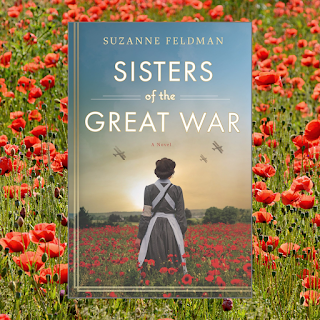
Blog Tour (Review & Excerpt): SISTERS OF THE GREAT WAR by Suzanne Feldman


SISTERS OF THE GREAT WAR

by
Suzanne Feldman


SISTERS OF THE GREAT WAR

Author: Suzanne Feldman

ISBN: 9780778311225

Publication Date: October 26, 2021

Publisher: MIRA Books


About the Book

Two sisters. The Great War looming. A chance to shape their future.

Sisters Ruth and Elise Duncan could never have anticipated volunteering for the war effort. But in 1914, the two women decide to make the harrowing journey from Baltimore to Ypres, Belgium in order to escape the suffocating restrictions placed on them by their father and carve a path for their own future.

Smart and practical Ruth is training as a nurse but dreams of becoming a doctor. In a time when women are restricted to assisting men in the field, she knows it will take great determination to prove herself, and sets out to find the one person who always believed in her: a handsome army doctor from England. For quiet Elise, joining the all female Ambulance Corps means a chance to explore her identity, and come to terms with the growing attraction she feels towards women. Especially the charming young ambulance driver who has captured her heart.

In the twilight of the Old World and the dawn of the new, both young women come of age in the face bombs, bullets and the deadly futility of trench warfare. Together they must challenge the rules society has placed on them in order to save lives: both the soldiers and the people they love.


***
My Thoughts

SISTERS OF THE GREAT WAR by Suzanne Feldman is set during the harrowing times of World War One. It’s the story of Americans, Ruth and Elise Duncan, and their time spent as war volunteers - Ruth, as a nurse, and Elise, as an ambulance driver.

Feldman tackles several key themes in the book. There’s the struggle for female autonomy. This is something that greatly affects Ruth as a woman trying to make her way in the male dominated field of medicine. There’s Ruth and Elise’s relationship with their staunchly patriarchal yet often hypocritical father - he’s a firm believer in traditional roles for women and yet he exploits both daughter’s skills in ‘male’ vocations for his own benefit. And then there is the war. Feldman doesn’t shy away from the horrors that soldiers and support staff faced. I liked that Feldman showed that for every person there a different motivation for being part of the war effort, and the story also raises the question of whether too high a price can be paid to win a war.

The ceaseless work of caring for the soldiers takes up a significant part of the story, and while I can imagine this is an accurate depiction, from a reader’s perspective I felt at times I was missing out on the opportunity to better connect with the characters.

If you’re interested in reading further about some of the themes found in this book, the author has kindly provided a list of sources. 


***
Excerpt

1

Baltimore, Maryland

August 1914


Ruth Duncan fanned herself with the newspaper in the summer heat as Grandpa Gerald put up a British flag outside the house. If he’d had a uniform—of any kind—he would have worn it. People on the sidewalk paused and pointed, but Grandpa, still a proper English gent even after almost twenty years in the U.S., smoothed his white beard and straightened his waistcoat, ignoring the onlookers.

“That’s done,” he said.

Ruth’s own interest in the war was limited to what she read in the paper from across the dining table. Grandpa would snap the paper open before he ate breakfast. She could see the headlines and the back side of the last page, but not much more. Grandpa would grunt his appreciation of whatever was in-side, snort at what displeased him, and sometimes laugh. On the 12th of August, the headline in the Baltimore Sun read; France And Great Britain Declare War On Austria-Hungary, and Grandpa wasn’t laughing.

Cook brought in the morning mail and put it on the table next to Grandpa. She was a round, grey-haired woman who left a puff of flour behind her wherever she went.

“Letter from England, sir,” Cook said, leaving the envelope and a dusting of flour on the dark mahogany. She smiled at Ruth and left for the kitchen.

Grandpa tore the letter open.

Ruth waited while he read. It was from Richard and Diane Doweling, his friends in London who still wrote to him after all these years. They’d sent their son, John, to Harvard in Massachusetts for his medical degree. Ruth had never met John Doweling, but she was jealous of him, his opportunities, his apparent successes. The Dowelings sent letters whenever John won some award or other. No doubt this was more of the same. Ruth drummed her fingers on the table and eyed the dining room clock. In ten minutes, she would need to catch the trolley that would take her up to the Loyola College of Nursing, where she would be taught more of the things she had already learned from her father. The nuns at Loyola were dedicated nurses, and they knew what they were doing. Some were out-standing teachers, but others were simply mired in the medicine of the last century. Ruth was frustrated and bored, but Father paid her tuition, and what Father wanted, Father got. 

Ruth tugged at her school uniform—a white apron over a long white dress, which would never see a spot of blood. “What do they say, Grandpa?”

He was frowning. “John is enlisting. They’ve rushed his graduation at Harvard so he can go home and join the Royal Army Medical Corps.”

“How can they rush graduation?” Ruth asked. “That seems silly. What if he misses a class in, say, diseases of the liver?”

Grandpa folded the letter and looked up. “I don’t think he’ll be treating diseases of the liver on the battlefield. Anyway, he’s coming to Baltimore before he ships out.”

“Here?” said Ruth in surprise. “But why?”

“For one thing,” said Grandpa, “I haven’t seen him since he was three years old. For another, you two have a common interest.”

“You mean medicine?” Ruth asked. “Oh, Grandpa. What could I possibly talk about with him? I’m not even a nurse yet, and he’s—he’s a doctor.” She spread her hands. “Should we discuss how to wrap a bandage?”

“As long as you discuss something.” He pushed the letter across the table to her and got up. “You’ll be showing him around town.”

“Me?” said Ruth. “Why me?”

“Because your sister—” Grandpa nodded at Elise, just clumping down the stairs in her nightgown and bathrobe “—has dirty fingernails.” He started up the stairs. “Good morning, my dear,” he said. “Do you know what time it is?” “Uh huh,” Elise mumbled as she slumped into her seat at the table.

As Grandpa continued up the stairs Ruth called after him. “But when is he coming?”

“His train arrives Saturday at noon,” Grandpa shouted back. “Find something nice to wear. You too, Elise.”

Elise rubbed her eyes. “What’s going on?”

Ruth pushed the letter at her and got up to go. “Read it,” she said. “You’ll see.”


Ruth made her way down Thirty-Third Street with her heavy bookbag slung over one shoulder, heading for the trolley stop, four blocks away, on Charles. Summer classes were almost over, and as usual, the August air in Baltimore was impenetrably hot and almost unbreathable. It irritated Ruth to think that she would arrive at Loyola sweaty under her arms, her hair frizzed around her nurse’s cap from the humidity. The nuns liked neatness, modest decorum. Not perspiring young women who wished they were somewhere else.

Elise, Ruth thought, as she waited for a break in the noisy traffic on Charles Street, could’ve driven her in the motor-car, but no, she’d slept late. Her younger sister could do pretty much anything, it seemed, except behave like a girl. Elise, who had been able to take apart Grandpa’s pocket watch and put it back together when she was six years old, was a use-ful mystery to both Father and Grandpa. She could fix the car—cheaper than the expensive mechanics. , For some rea-son, Elise wasn’t obliged to submit to the same expectations as Ruth—she could keep her nails short and dirty. Ruth wondered, as she had since she was a girl, if it was her younger sister’s looks. She was a mirror image of their mother, who had died in childbirth with Elise. Did that make her special in Father’s eyes?

An iceman drove a sweating horse past her. The horse raised its tail, grunted, and dropped a pile of manure, rank in the heat, right in front of her, as though to auger the rest of her day. The iceman twisted in the cart to tip his hat. “Sorry Sister!”

Ruth let her breath out through her teeth. Maybe the truth of the matter was that she was the ‘sorry sister.’ It was at this exact corner that her dreams of becoming a doctor, to follow in her father’s footsteps, had been shot down. When she was ten, and the governess said she’d done well on her writing and math, she was allowed to start going along on Father’s house calls and help in his office downstairs. Father had let her do simple things at first; mix plaster while he positioned a broken ankle, give medicine to children with the grippe, but she watched everything he did and listened carefully. By the time she was twelve, she could give him a diagnosis, and she remembered her first one vividly, identifying a man’s abdominal pain as appendicitis.

“You did a good job,” Father had said to her, as he’d reined old Bess around this very corner. “You’ll make an excellent nurse one day.”

Ruth remembered laughing because she’d thought he was joking. Her father’s praise was like gold. “A nurse?” she’d said. “One day I’ll be a doctor, just like you!”

“Yes, a nurse,” he’d said firmly, without a hint of a smile. It was the tone he used for patients who wouldn’t take their medicine.

“But I want to be a doctor.”

“I’m sorry,” he said. He hadn’t sounded sorry at all. “Girls don’t become doctors. They become nurses and wives. Tomorrow, if there’s time, we’ll visit a nursing college. When you’re eighteen, that’s where you’ll go.”

“But—”

He’d shaken his head sharply, cutting her off. “It isn’t done, and I don’t want to hear another word about it.”

A decade later, Ruth could still feel the shock in her heart. It had never occurred to her that she couldn’t be a doctor because she was a girl. And now, John Doweling was coming to town to cement her future as a doctor’s wife. That was what everyone had in mind. She knew it. Maybe John didn’t know yet, but he was the only one.

Ruth frowned and lifted her skirts with one hand, balancing the bookbag with the other, and stepped around the manure as the trolley came clanging up Charles.


*

Excerpted from Sisters of the Great War by Suzanne Feldman, Copyright © 2021 by Suzanne Feldman. Published by arrangement with Harlequin Books S.A.


***
About the Author


Suzanne Feldman, a recipient of the Missouri Review Editors' Prize and a finalist for the Bakeless Prize in fiction, holds an MA in fiction from Johns Hopkins University and a BFA in art from the Maryland Institute College of Art. Her short fiction has appeared in Narrative, The Missouri Review, Gargoyle, and other literary journals. She lives in Frederick, Maryland.


Social Links:

Author Website

Twitter: @suzanne21702

Facebook: @SuzanneFeldman

Instagram: @suzannefeldmanauthor

Goodreads